





Industrial Data Platforms Development
We design and implement industrial data platforms that unify OT and IT data into a governed, production-grade industrial data platform. Built for real industrial context, our platforms allow secure integration, audit-ready compliance, and scalable industrial data infrastructure across sites and systems.


Industrial data platforms engineered for scale and control
We build industrial data platforms that standardize industrial data integration across sites, eliminate manual data handling, and establish a governed enterprise data platform for industry with full lineage, role-based access, and compliance built in.
Production-grade industrial data platforms for complex environments
We deliver industrial data platform development that establishes a governed environment for secure OT IT integration, scalable data infrastructure, and compliance across regulated, multi-site operations.
Industrial data architecture and integration foundation
- Integration of SCADA, PLC, MES, ERP, and IoT through robust industrial data integration patterns
- Vendor-agnostic industrial data architecture supporting Data Lake, Data Mesh, and federated models
- Foundation for time series data analytics and advanced industrial use cases
Governance, compliance, and operational reliability
- Full lineage and traceability for audit-ready GxP data platforms
- Role-based access control across the platform with 100% coverage
- Stable integration of industrial data systems without impact on production operations

Industrial data platforms built for operational continuity and control
We deliver industrial data platform development that unifies OT and IT data into a governed environment, enabling reliable industrial data integration, scalable industrial data infrastructure, and compliance in complex, regulated industrial context.

Integration of SCADA, PLC, MES, and IoT is designed to run alongside existing operations, ensuring stable OT IT integration without impacting performance or uptime.

We design industrial data architecture and industrial data systems architecture that scale across sites, support cross-site enterprise data integration, and eliminate one-off, non-reusable solutions.

Built-in lineage, traceability, and role-based access control ensure compliance, support GxP data platforms, and provide full visibility across the industrial data platform.
Use Cases

We design and implement IoT-based data platforms that centralize event data from distributed industrial devices into a unified data environment. This allows real-time operational visibility, supports BI analytics, and implementation of automated control and management logic across production environments. The architecture is built to ensure scalability, data consistency, and seamless integration with existing systems.


We design and develop IoT and AI-powered data platforms for utility infrastructure operators, enabling real-time anomaly detection, predictive analytics, and automated alerting across distributed metering networks. Such a solution can significantly reduce incident detection time from 24 hours to 15–30 minutes, improving operational response, system reliability, and decision-making speed.

We design and develop data platforms for environments, where reliability and integration with physical systems are critical. They support real-time data collection, processing, as well as system monitoring in harsh operating conditions. The architecture allows robust performance, seamless integration with field infrastructure, and consistent data availability for operational and analytical use.
We design and build data architectures for regulated industries, where compliance, data integrity, and auditability are essential. These systems support secure data access, full traceability, and consistent data governance across operations. The architecture is aligned with regulatory requirements and designed to ensure reliability, transparency, and long-term data integrity.

Industries We Serve
Our engineering capabilities are deployed across regulated, mission-critical and industrial sectors.

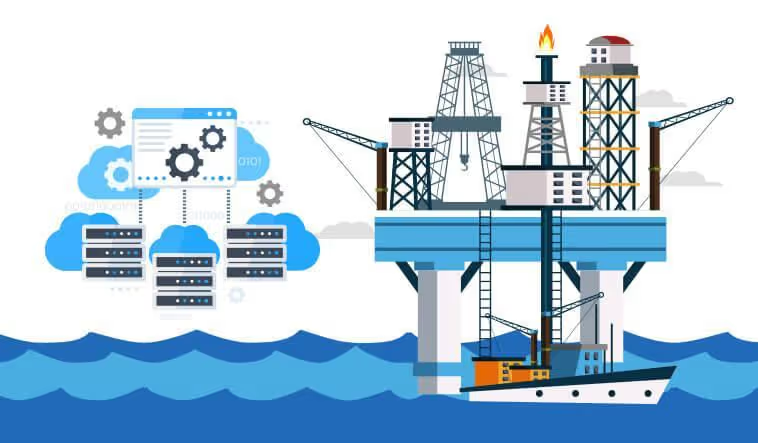
Industrial data platforms and OT/IT integration for Oil & Gas operations - audit-ready, production-grade.

GxP-compliant data platforms, Data Mesh and OT/IT integration for pharmaceutical manufacturing and. diagnostics.

Industrial IoT platforms, energy monitoring and OT/IT integration for
manufacturing operations - Vossloh, Mondi reference.
FAQs
If you have additional questions or would like to discuss your requirements, feel free to get in touch with our team.
An industrial data platform is a system that collects, processes and manages data from industrial sources such as machines, sensors and control systems. It enables data aggregation across OT and IT environments for monitoring, analytics and decision-making. These platforms must operate reliably under continuous data flow and integration constraints.
Industrial data platform development includes building data ingestion pipelines, storage layers, processing mechanisms and integration with external systems. It also involves handling industrial protocols, ensuring data consistency and enabling real-time or near real-time data processing. The platform must support scalability and long-term operation.
Integration involves connecting to PLCs, SCADA systems and other industrial devices using appropriate communication protocols and interfaces. Data is normalised, validated and routed into processing pipelines or storage systems. Proper integration ensures reliable data flow without disrupting operational systems.
Key challenges include inconsistent data formats, unreliable connectivity, large data volumes and strict uptime requirements. Additional complexity comes from integrating legacy systems and maintaining data integrity across distributed environments. These platforms must handle both real-time and historical data efficiently.
Data reliability is ensured through validation mechanisms, fault handling and redundancy strategies within data pipelines. Systems are designed to detect anomalies, handle missing data and maintain consistency across sources. Validation is performed under real operating conditions.
Real-time data processing enables immediate visibility into system performance, anomalies and operational states. It supports use cases such as predictive maintenance, process optimisation and alerting. In many environments, low-latency data handling is critical for effective decision-making.
Discuss your product with our R&D team
This initial conversation is focused on understanding your product, technical challenges, and constraints.
No sales pitch - just a practical discussion with experienced engineers.



Share a few details about your product and context. We’ll review the information and suggest the most appropriate next step.