

Embedded systems operate in an environment where precision, performance, and resource control are of paramount importance. Unlike traditional software development, embedded programming requires not only proficiency in programming languages but also a deep understanding of hardware architecture and code optimization for resource-constrained devices. Choosing the right programming language can determine a project's success—ensuring it remains fast, energy-efficient, and stable, rather than a source of performance and security issues.
Which language will work best for your project? What are their advantages and limitations? What challenges will you face when programming embedded software? In this article, we compare the most popular programming languages for embedded systems and help you find the one that best suits your needs.
std::unique_ptr, std::shared_ptr), helps eliminate memory leaks, one of the biggest issues in traditional C. C++ also allows for performance optimization through function inlining, templates, and advanced compilation techniques, enabling efficient resource management within embedded systems.However, its more complex syntax and extensive functionality make C++ code harder to analyze and slower to compile. Recent data indicates that C++ has grown to be used in 20–25% of embedded projects. Moreover, features like exceptions, dynamic memory allocation, and standard library parts may introduce higher resource overhead, limiting their suitability for low-power embedded systems. Despite these challenges, C++ remains an excellent choice for projects that require both high performance and better code organization, especially in sectors such as automotive, IoT, and robotics, where complex algorithms and multi-layered architecture are essential for efficient system operation.🔹 When object-oriented programming is required – C++ allows better code organization, making it easier to develop large-scale applications.
🔹 If resource optimization is crucial – Features like function inlining and efficient data structures help save memory and computational power.
🔹 When scalability is important – C++ works well in systems that may evolve and require expanded functionality in the future.
🔹 If advanced memory management is needed – Smart pointers and RAII (Resource Acquisition Is Initialization) help minimize memory leaks.
🔹 For processing large amounts of data – Built-in optimization mechanisms allow efficient data operations, which is key for control and analytics systems.
🔹 When integrating with existing libraries – C++ is widely used in libraries for data analysis, graphics, and AI, making it easier to implement in modern embedded systems.
Although traditionally associated with high-level applications, Python has gained popularity in embedded systems, particularly in IoT, data analysis, and rapid prototyping. Thanks to its readable syntax, dynamic typing, and extensive library ecosystem, including MicroPython and CircuitPython, it enables seamless integration with microcontrollers and facilitates quick testing of new features without the need for low-level memory management. Its use is especially beneficial in projects requiring frequent updates, interaction with sensors, and communication systems.
However, as an interpreted language, Python has its limitations. Compared to C and C++, it runs slower and consumes more memory, which can challenge resource-constrained systems. The lack of precise hardware control makes it unsuitable for applications requiring strict timing synchronization or minimal latency. As a result, Python is primarily used in the application layer of embedded systems, whereas performance-critical components are typically implemented in more efficient languages. Its greatest advantage is the ability to rapidly prototype and iteratively develop solutions, making it a valuable tool for engineers working on smart devices and IoT systems.
🔹 Easy integration with cloud services – Python is well-suited for communication with cloud platforms such as AWS IoT, Google Cloud IoT, and Azure IoT.
🔹 Support for communication protocols – Libraries supporting MQTT, CoAP, and WebSockets simplify the development of distributed IoT systems.
🔹 Availability of data analysis tools – Libraries like NumPy, Pandas, and SciPy enable data processing and analysis directly within an embedded system.
🔹 Support for Machine Learning – Python allows the integration of AI models within embedded devices, using frameworks like TensorFlow Lite, making it useful in smart IoT systems.
🔹 Hardware interface support – Python offers compatibility with popular interfaces such as I2C, SPI, and UART, facilitating the control of connected peripheral devices.
🔹 Automation of processes – Python is ideal for automating the configuration of embedded devices and production processes, simplifying embedded system management.
🔹 Support for multithreading and asynchronous programming – Libraries such as asyncio enable the optimization of communication processes and concurrent execution of multiple operations, which is useful in real-time systems.
Rust is gaining increasing popularity as a modern programming language for embedded systems, offering high performance comparable to C and C++ along with advanced memory safety mechanisms. As stated by Graydon Hoare, creator of Rust: "Rust brings a new level of safety and reliability to embedded programming".
One of its key advantages is the borrow checker system, which eliminates classic memory management errors such as buffer overflows and null pointers, ensuring greater system stability. With no runtime or garbage collector, Rust is ideally suited for resource-constrained systems, where full memory control and deterministic management of object lifecycles are crucial. Additionally, its modern development tools, including Cargo, simplify dependency management and code optimization, accelerating software development.
Although Rust offers many benefits, its complex syntax and strict memory management rules make learning more time-consuming compared to C or C++. Furthermore, despite a rapidly growing ecosystem, Rust still has fewer libraries and tools supporting embedded systems than more established languages. Nevertheless, in applications requiring high security and reliability, such as aerospace, medical devices, or industrial automation, Rust is becoming an increasingly popular choice for embedded engineers seeking modern and safe solutions.
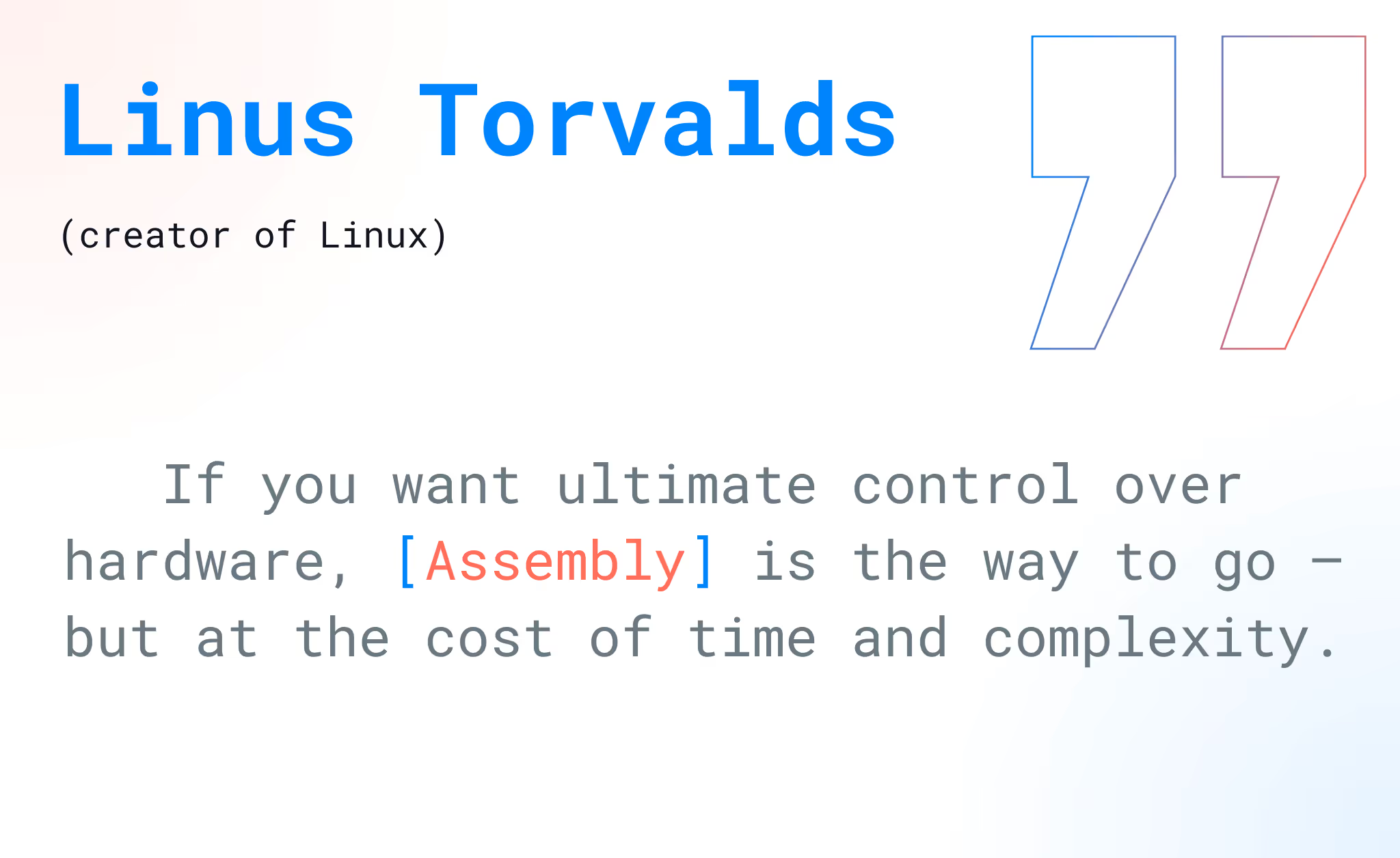
Assembly language is a low-level programming language that provides full control over hardware, making it essential for embedded systems that require maximum performance and precision. Programming in assembly allows direct manipulation of processor registers, memory control, and code optimization tailored to specific hardware architectures. As a result, it is often used in critical system components, such as interrupt handling, peripheral device control, and bootloader implementation. Its biggest advantage is the ability to write highly optimized code that runs faster and consumes fewer resources than code generated by high-level language compilers.
However, programming in assembly presents certain challenges. Assembly code is difficult to maintain and less portable, as it is directly tied to the architecture of a specific processor. Programming in assembly also requires more time and precision, making it most suitable for applications where every processor cycle matters. In modern embedded systems, assembly is typically used only for optimizing critical sections of code, while the rest of the software is developed using more readable and flexible languages like C, C++, or Rust.
🔹 Full control over bit-level operations – Enables precise manipulation of individual bits in processor registers and peripheral devices.
🔹 Minimization of compiler overhead – Assembly allows exact control over which instructions are executed by the processor, eliminating unnecessary operations generated by high-level language compilers.
🔹 Optimization of power consumption – Manual control over processor cycles and input/output operations enables better energy management in low-power devices.
🔹 Use in critical system components – Assembly is employed in boot sequences, exception handling, and microcontroller initialization routines.
🔹 Integration with C and C++ code – In many projects, assembly is used only as inline assembly within C or C++ programs.
🔹 Requirement for deep hardware knowledge – Programming in assembly demands an in-depth understanding of the processor, its instruction set, and memory organization, making it a steeper learning curve for new developers.
🔹 Longer development and testing time – Writing assembly code is more time-consuming than using high-level languages, and debugging often involves working at the register level.
🔹 Specialized applications – Assembly is widely used in Digital Signal Processing (DSP) units, motor controllers, and real-time operating systems (RTOS), where performance optimization is crucial.
Memory management – Embedded systems often have limited RAM and ROM, requiring precise memory management. Dynamic allocation can lead to fragmentation and memory leaks, affecting system stability and performance.
Power consumption optimization – In battery-powered devices, every inefficient operation can shorten battery life. Effective power management involves using low-power modes, dynamically adjusting processor clock speeds, and selecting energy-efficient components.
Real-time processing – Many embedded systems operate in real-time environments (RTOS), where low latency and deterministic code execution are critical. Challenges arise in handling interrupts, task synchronization, and process scheduling.
Hardware integration – Embedded software must interact with various peripherals, such as sensors, communication modules (I2C, SPI, UART), motor controllers, and displays. Each component may have different requirements, making integration complex and requiring extensive testing.
Debugging and testing – Diagnosing issues in embedded systems is more difficult than in traditional software, as advanced debugging tools are not always available. Many issues can only be detected through testing on actual hardware, extending development time.
System security – In IoT, industrial automation, and medical systems, any security vulnerability can pose a significant risk. Developers must implement data encryption, secure firmware updates, and protection against external attacks to ensure system reliability.
Hardware constraints – Unlike PCs, embedded systems often operate on low-power processors with limited resources such as memory, computing power, and communication bandwidth. Developers must optimize their code to ensure efficiency under these constraints.
Each of these challenges requires experience and knowledge of both hardware and software, making embedded systems development more demanding than traditional software engineering.
If you're considering embedded software development outsourcing for your company, we encourage you to check out our article:
https://intechhouse.com/blog/how-embedded-software-development-outsourcing-works-guide-for-ctos/
Which programming language is best for embedded systems?
There is no single best language—it all depends on the project requirements. C is the most commonly chosen language due to its high performance and full control over hardware. C++ is suitable for larger and more complex systems, offering object-oriented programming. Python is useful for prototyping and IoT applications, while Rust provides memory safety while maintaining performance comparable to C.
Why is C still the dominant language in embedded systems?
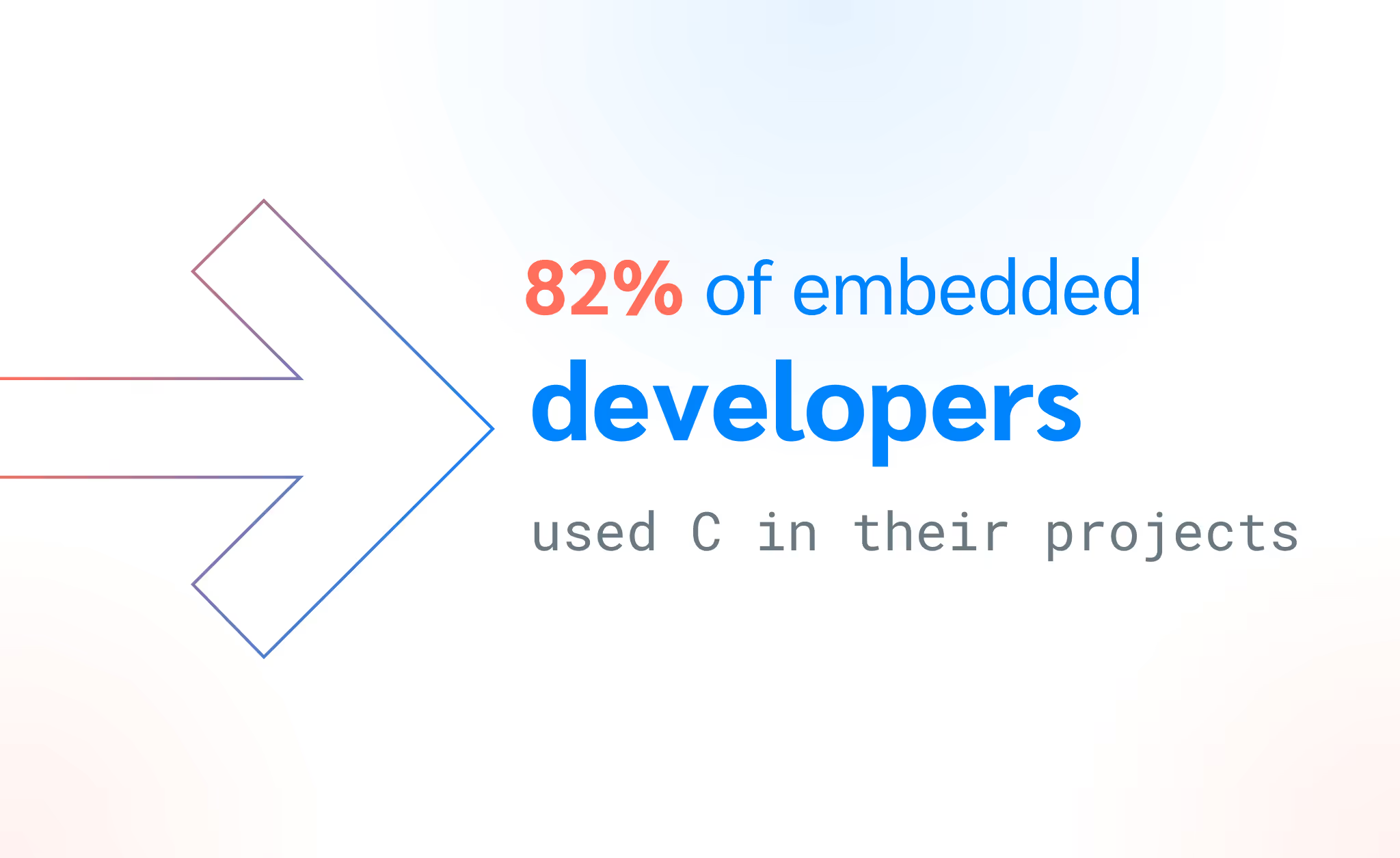
C is an efficient language that allows direct control over hardware and low-level operations. Its lack of a runtime and garbage collector makes it deterministic, which is crucial for real-time systems. Additionally, it is widely supported by most microcontrollers and embedded platforms.
Can rust replace C in embedded systems?
Rust offers high performance comparable to C while providing memory safety mechanisms that eliminate pointer-related errors and buffer overflows. However, due to its more complex syntax and a smaller ecosystem of tools for embedded development, its adoption is still growing but has not yet replaced C.
Which language is best for IoT projects?
It depends on the system layer. C and C++ are used in IoT firmware, ensuring high performance. Python is commonly used for control applications, data analytics, and cloud communication. Rust is gaining popularity in IoT due to its safety features and elimination of pointer-related errors.
Can embedded systems use Java or JavaScript?
Java is rarely used in traditional embedded systems due to its high memory requirements and the presence of a virtual machine (JVM), but it can be utilized in smart devices and mobile applications. JavaScript (e.g., Espruino) is used in simple IoT systems but is not suitable for applications requiring high performance.
A technology leader specializing in hardware and embedded systems.
He has extensive experience delivering complex engineering projects for industries such as energy, military & defence, and aerospace.
His work centers on developing reliable, high-performance hardware systems designed for demanding environments and long-term industrial deployment. Adam combines deep technical expertise with practical engineering leadership, helping transform advanced embedded technologies into robust, mission-critical solutions used by global clients.
This initial conversation is focused on understanding your product, technical challenges, and constraints.
No sales pitch - just a practical discussion with experienced engineers.
Share a few details about your product and context. We’ll review the information and suggest the most appropriate next step.