Embedded systems are everywhere around us, from the devices we use in our daily lives to the complex machinery that drives industries. These systems are designed to perform specific functions and operate within tight constraints, often with limited resources. To effectively program such systems, developers rely on various architectural patterns, one of which is the foreground-background, commonly known as the “superloop” architecture. In this article, we will explore the super loop architecture and its benefits in embedded systems programming.


While the Superloop architecture offers several advantages, it is essential to consider its limitations:
Despite its advantages, the superloop architecture does have some limitations. It requires careful consideration of task priorities and timing requirements to ensure that critical operations are not starved of resources. Without proper design and resource management, non-time-critical tasks in the background may inadvertently affect the timing of critical tasks in the foreground. Additionally, complex systems with a high number of concurrent tasks may require more sophisticated scheduling techniques to maintain timing guarantees.To mitigate these limitations, developers often employ techniques such as
INTechHouse has extensive experience working with Superloop architecture in various embedded systems projects. Our team of skilled engineers has successfully implemented Superloop-based designs to develop efficient and reliable solutions for our clients.One notable project where we applied Superloop architecture was the development of a real-time data acquisition and control system for an industrial automation application. The system required precise control of multiple actuators and sensors in a time-critical environment.By utilizing Superloop architecture, we were able to achieve deterministic behaviour and meet the stringent timing requirements of the application. The foreground loop of the Superloop handled critical tasks such as sensor data acquisition, actuator control, and real-time decision-making, while the background loop managed non-time-critical tasks and peripheral communication.
While the Superloop architecture has been widely used, modern embedded systems are increasingly adopting more complex architectures and scheduling techniques, such as preemptive multitasking, real-time operating systems (RTOS), and event-driven programming. These alternatives provide enhanced flexibility, task prioritization, and resource management capabilities.
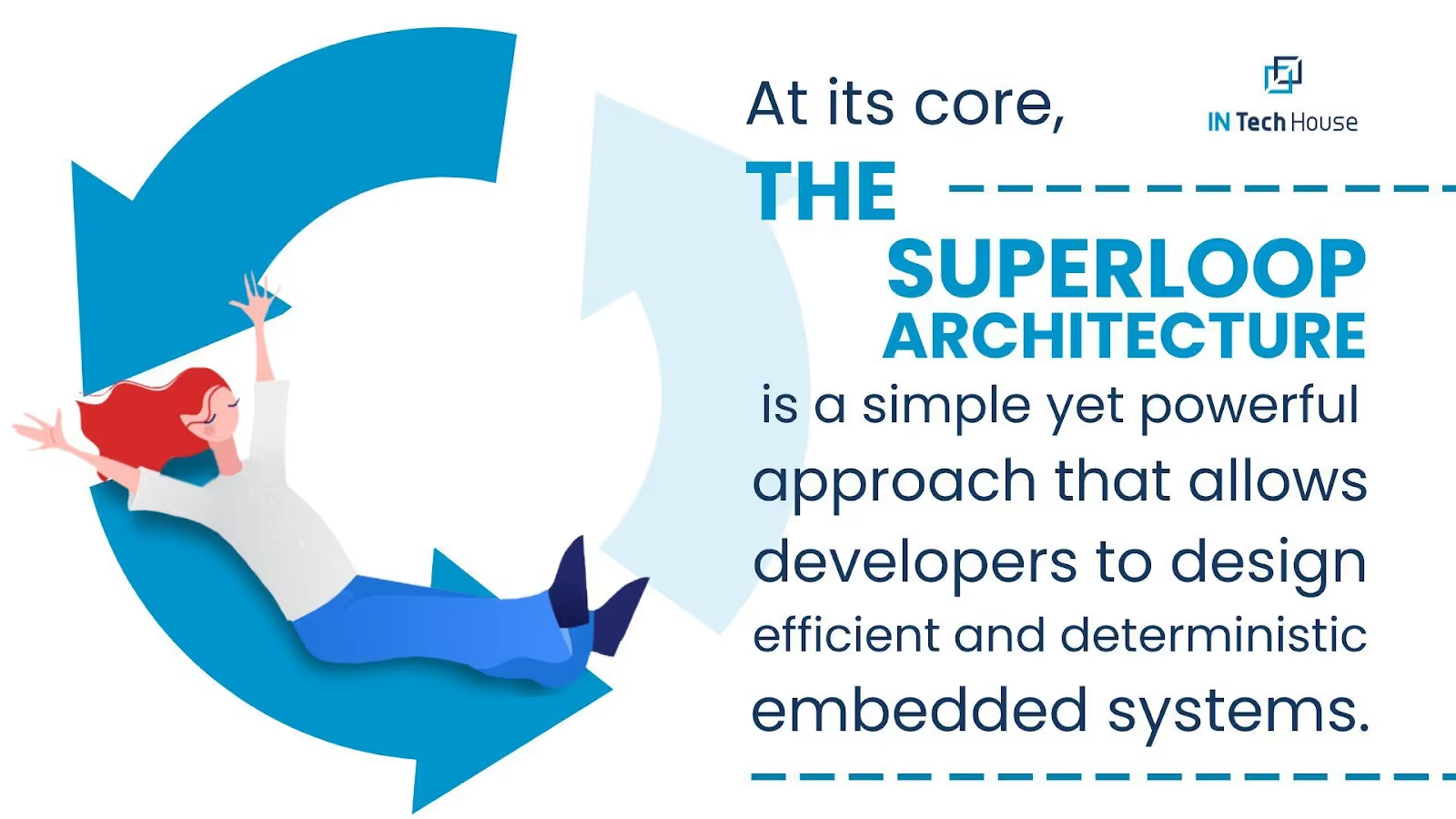
The foreground-background or superloop architecture is a powerful and widely used approach for embedded systems programming. Its simplicity, modularity, and responsiveness make it an ideal choice for many real-time and resource-constrained applications. By separating time-critical and non-time-critical tasks, developers can design efficient and deterministic systems that meet stringent timing requirements. While it requires careful consideration of task priorities and resource management, the super loop architecture remains a valuable tool in the embedded systems programmer’s arsenal.As technology continues to advance, embedded systems will become even more prevalent, requiring efficient programming techniques. Understanding and utilizing architectural patterns like the superloop architecture will empower developers to create robust and reliable embedded systems that drive innovation across various industries.
Superloop is better to use for?The Superloop architecture has been widely used in the development of small to medium-scale embedded systems for several decades. It has been a prevalent approach in various industries, including automotive, consumer electronics, industrial automation, and IoT devices.For which kinds of tasks is superloop effective?Many companies and developers have adopted the Superloop architecture as a straightforward and efficient solution for managing real-time tasks and resource-constrained systems. Its simplicity and ease of implementation have made it a popular choice, especially for less complex applications.Where you can’t use superloop?While Superloop may not be as prevalent in larger-scale systems today, it continues to be used in simpler embedded applications where its lightweight nature and deterministic behaviour are advantageous.What does the super loop include?The Superloop architecture in embedded systems typically includes the following components:InitializationForeground LoopBackground LoopInterrupt Service Routines (ISRs)Task SchedulingPeripherals and Drivers
This initial conversation is focused on understanding your product, technical challenges, and constraints.
No sales pitch - just a practical discussion with experienced engineers.
Share a few details about your product and context. We’ll review the information and suggest the most appropriate next step.